From chaotic backtracking to clean neighborhood sweeps 从混乱折返,到整齐的逐街区扫街
A vehicle-routing optimizer for multi-day delivery across Montreal, built on Google OR-Tools, with constraints that encode how good drivers actually work. 覆盖蒙特利尔的多日配送路径优化器,基于 Google OR-Tools,用约束条件把好司机的开车习惯写进模型。
2026-07-07 · updated 2026-08-08 · first published on boheastill.com最初发表于 boheastill.com
The problem
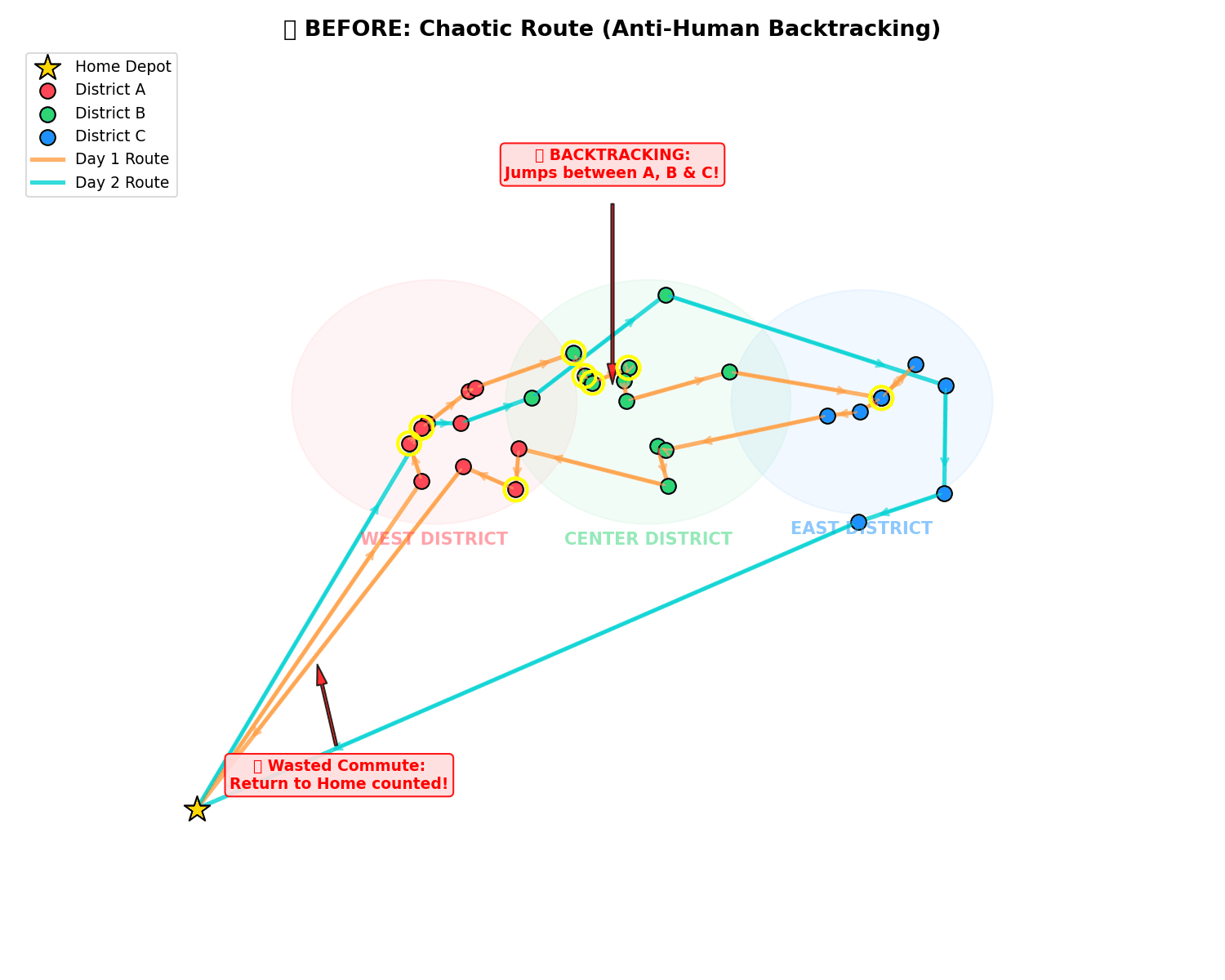
Naive shortest-path routing produces plans that look optimal on paper and make no sense behind the wheel. The route zig-zags between distant neighborhoods, doubles back late in the day, and the “return home” leg pulls afternoon stops in odd directions. Drivers ignore plans like that, and a plan drivers ignore is worthless.
The constraint
The optimizer had to respect three things standard VRP formulations don’t give you for free:
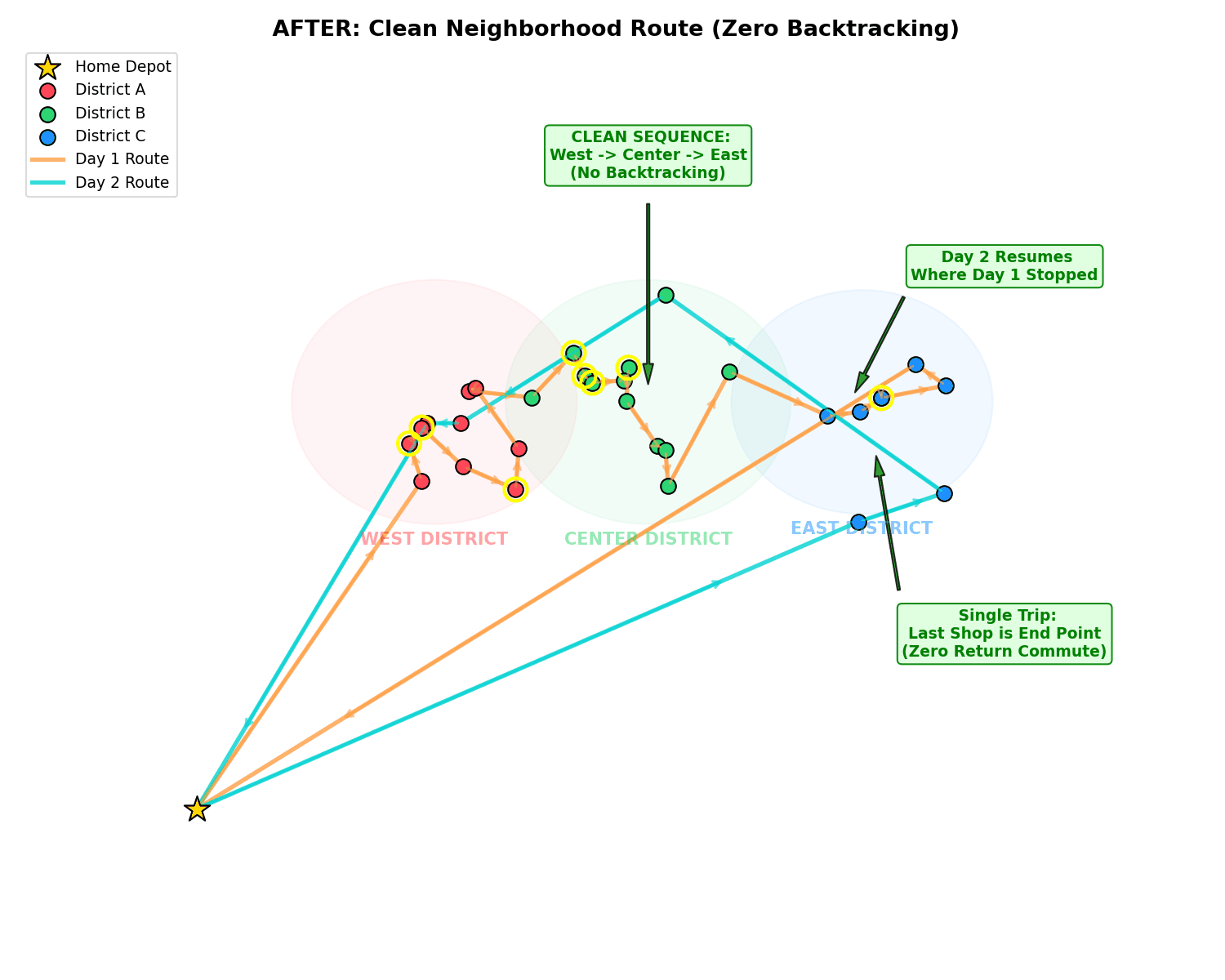
- Finish a neighborhood before leaving it. Once a driver enters a district, all stops there get done. No coming back tomorrow for one missed address.
- The commute home doesn’t count. The drive back to the depot shouldn’t distort where the last deliveries of the day go.
- Days connect. Whatever is left over from Day 1 must anchor the start of Day 2, so the driver resumes where they stopped rather than from a fresh shuffle.
The solution
- Open VRP modelling. The return-to-depot arc is weighted to zero, mathematically removing the “pull” that home exerts on late-day stops.
- District contiguity. Constraint-programming indicator variables mean that entering a district commits the solver to completing it.
- Cross-day carryover. Leftover stops persist, so Day 2 inherits yesterday’s active district before opening new zones.
- Graceful degradation. Where hyper-dense areas make a hard constraint infeasible, the solver relaxes it into a soft penalty rather than failing.
- An interactive Leaflet map with toggleable route layers and direction animations, so the client could see the difference instead of reading distance tables.
Proof: see it, don’t take my word for it
Where else this applies
Field-service scheduling, last-mile delivery, sales-territory planning, technician dispatch. Any operation where "the math says drive across town twice" costs you real fuel and real morale.
问题
简单的最短路径算法排出的计划,纸面上最优,开起来却很离谱:路线在相隔很远的街区之间来回跳,快收工了还要折返,“回仓库”这一段还把下午的配送点拉向奇怪的方向。司机不会照这种计划开,而司机不照着开的计划毫无用处。
约束
优化器必须满足三件标准 VRP 模型不会白送你的事:
- **进了一个片区就跑完再走。**司机一旦进入某个片区,里面的点要全部送完,不能第二天再回来补一个漏掉的地址。
- **回家的路不计成本。**开回仓库的通勤路程,不应该扭曲当天最后几单的走向。
- **前后两天要衔接。**第一天剩下的点要作为第二天的起点,司机从昨天停下的地方接着跑,而不是重新排一遍。
方案
- **Open VRP 建模。**把返回仓库那段路的权重设为零,从数学上去掉“回家”对傍晚配送点的拉扯。
- **片区连续性。**用约束规划里的指示变量表达:一旦进入某个片区,求解器就必须把它跑完。
- **跨天延续。**剩余的配送点会保留下来,第二天先接着跑昨天没完成的片区,再开新的。
- **平滑降级。**遇到点位特别密集、硬约束无解的区域,求解器会把它放宽成软惩罚,而不是直接失败。
- 交互式 Leaflet 地图,路线图层可以切换,带方向动画,客户能直接看到差别,不用去读里程表。
证明:眼见为实,不用信我的话
还能用在哪
上门服务排班、最后一公里配送、销售片区规划、技师派单。凡是算法让你横穿全城两趟、白白浪费油钱和司机耐心的场景,都适用。